
Ten of the largest advertisers spent a combined $41.1 million in September 2026, according to Podcast News Daily, which means spend was up a whopping 20.9% from August. Floodlight, a programmatic ad solutions provider, dives into how podcast advertising has changed since early spring. In terms of spend, this past September was the strongest month since March.
TL;DR: Spending by podcasting's top 10 advertisers rose to an estimated $41.1 million in September, driven primarily by betting and prediction market apps and a growing ChatGPT campaign.
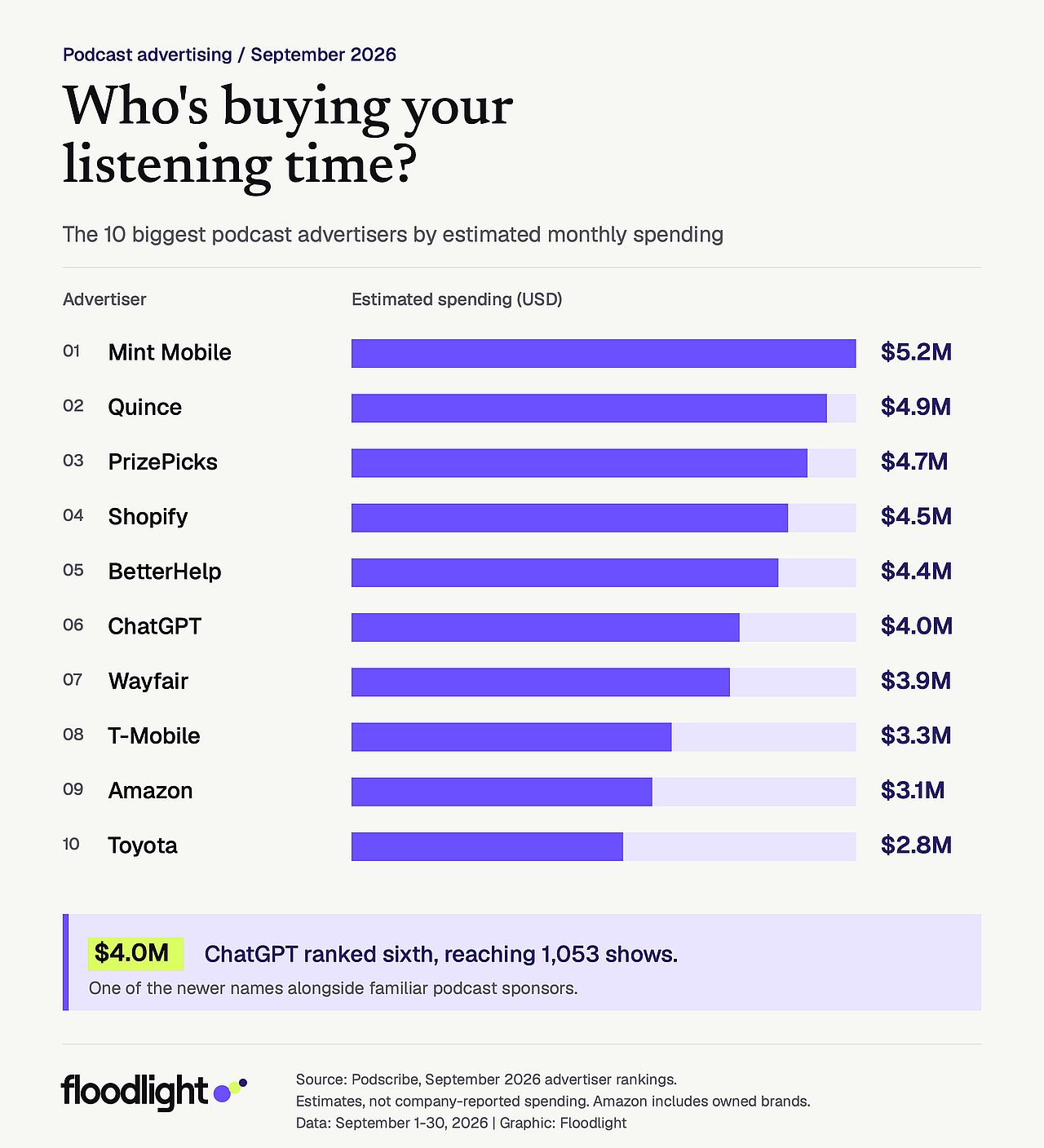
Mint Mobile stayed at No. 1 for the second month in a row, with an estimated $5.2 million in podcast ad spending according to Podscribe. In second place is Quince, a “budget-friendly luxury” clothing company. It spent about $4.9 million. While the companies actually decreased their ad spend from August to September, they still held these top spots.
PrizePicks, a fantasy sports app, leaped from ninth place in August to third place in September after raising its estimated spend 64% to $4.7 million. Its ads ran on 539 shows, and 92% of them were read by the hosts themselves. That pushed PrizePicks past two longtime podcast staples: Shopify (the all-in-one commerce platform) spent about $4.5 million, and BetterHelp (the online therapy service) spent about $4.4 million.
BetterHelp leaned mostly on comedy podcasts, and 85% of its ads across 775 shows were read by the host.
Podscribe also found that four of the 10 fastest risers were sports wagering, fantasy sports or prediction market companies, and together they spent an estimated $9.8 million in September.
Over the past few years, DraftKings, Polymarket, and Kalshi have dominated cross-channel advertising as they compete to become the industry leader when it comes to trading and betting on sports. Given that, they’ve been increasing advertising investment accordingly. DraftKings more than doubled its spending (up 109% to $2.4 million) with ads on 794 shows. Polymarket raised its spend 834% to $1.5 million, and Kalshi grew 63% to $1.2 million. Both prediction markets focused heavily on sports programming.
Podcasts may be one of the easier places for them to buy attention, especially since the NFL kept prediction market ads off the 2026 Super Bowl broadcast. It’s likely that we’ll continue to see regulations around how these platforms market themselves and where they’re permitted to operate.
Prediction markets describe themselves as “federally regulated exchanges,” not sportsbooks, but that claim is being fought in court. The Commodity Futures Trading Commission has sued nine states that tried to restrict these platforms, Kentucky’s attorney general has sued Kalshi and Polymarket under state gambling law, and a Supreme Court ruling is widely expected as soon as next year.
Note: Listeners who find betting harder to stop than to start can reach the National Council on Problem Gambling’s helpline at 1-800-GAMBLER.
While there is a lot of discussion around prediction markets, there were some increased spenders that don’t fall in that category. Taco Bell increased its estimated podcast spend 7,955% to $1.3 million and showed up on 1,021 shows, Lingo Kids Grown Up rose 345% to $2 million, Disney rose 101% to $1.8 million, and Lowe’s rose 57% to $1.7 million.
OpenAI's chatbot first entered Podscribe's top 10 in August with about $3 million in estimated spending. In September it spent roughly $4 million, moving from seventh to sixth. Its ads reached 1,053 shows, and sports was its leading genre.
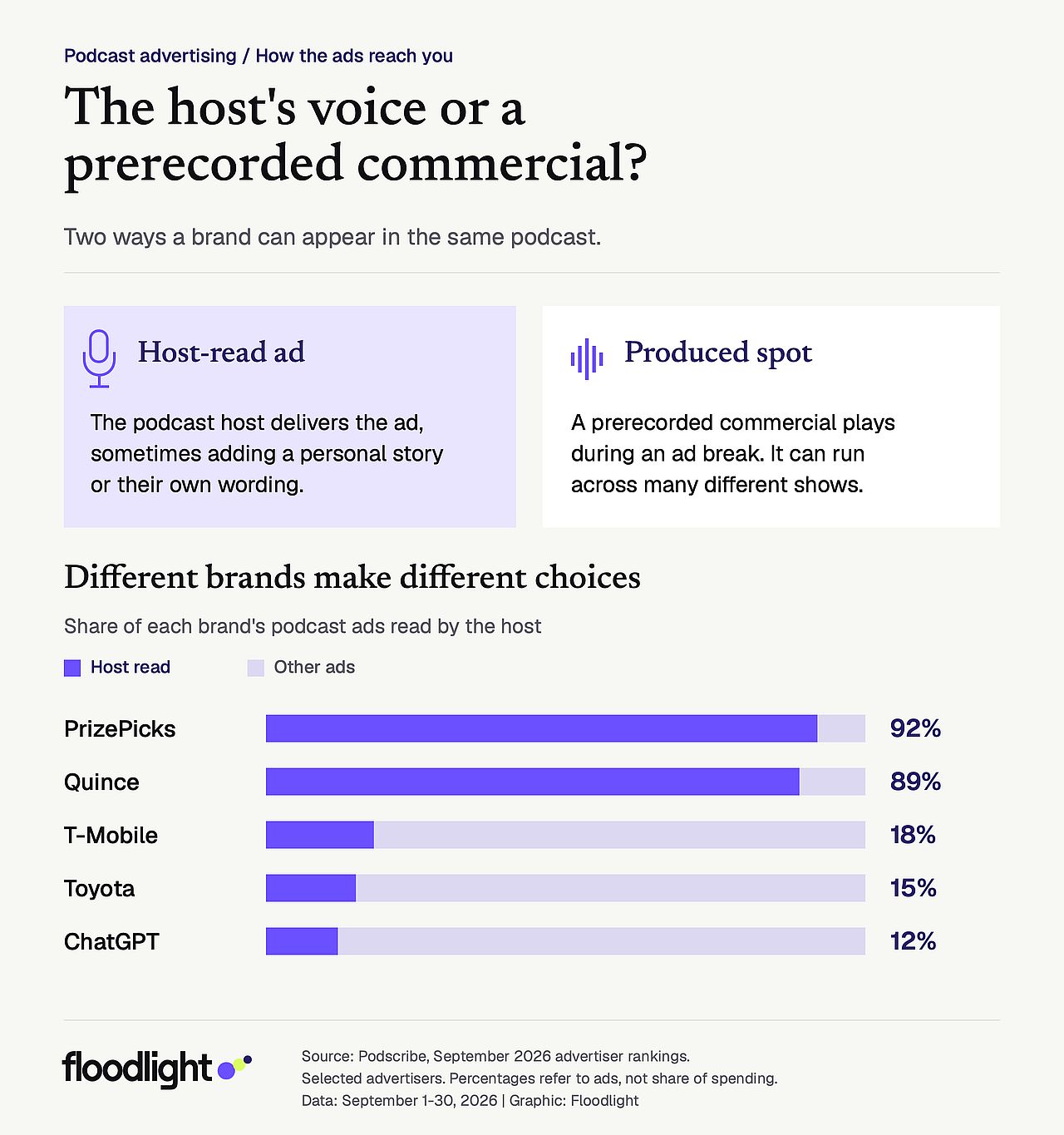
Only 12% of ChatGPT's podcast ads were host reads. The rest were produced spots inserted into episodes.
In February, OpenAI began showing ads to logged-in U.S. adults on ChatGPT's free and Go tiers. The company now sells ad space inside its own product while buying ad space across more than a thousand podcasts to bring new users in. Now that OpenAI has a revenue model, it’s pouring gas on ad spend.
What’s The Difference?
A host read is an ad delivered by the podcast's host. This is usually in their own words and sometimes has some sort of personal story or anecdote attached. On the other hand, a produced spot is a prerecorded commercial dropped into the episode, often the same one running on dozens or even hundreds of other shows.
Many produced spots are bought programmatically, meaning software places them automatically instead of a person negotiating each deal with each show. The ad is stitched into the episode during ad breaks, which is why two people can play the same episode and hear different ads, and why a three-year-old episode can share an ad for something that just launched last week.
These two mediums were split pretty sharply in September. PrizePicks used host reads for 92% of its placements and Quince for 89%. Conversely, ChatGPT only used them for 12%, Toyota for 15% and T-Mobile for 18%.
Why Ad Placement Matters for Listeners
Host reads can work because listeners trust the voice. Take Mel Robbins, for example. She’s talked with leading experts about mental health and has been vulnerable about her ADHD. A listener who frequents the podcast is more likely to trust Mel Robbins if she recommends a book about ADHD. That trust is what advertisers pay extra for. Another example is the “Huberman Lab” podcast. Dr. Andrew Huberman frequently recommends Our Place pans for health and safety reasons, aligning with what his listeners care about.
Federal Trade Commission rules require endorsers to disclose paid relationships, and most hosts do, usually with a "this episode is brought to you by" line or a promo code. A host saying a product changed their life may be completely sincere. It is still a paid statement, and it is fair to weigh it the way one would weigh a friend's recommendation if that friend got a check for making it.
As mentioned, getting the host to personally tie their name to your company isn’t cheap. That’s where programmatic audio advertising comes in. This is a much more affordable option and allows you to segment listeners.
According to the Interactive Advertising Bureau and PwC, U.S. podcast ad revenue grew 17.6% to $2.9 billion in 2025, while TV advertising dropped 13.4% over the same period.
Audiences have also grown alongside the spending. Edison Research's Infinite Dial 2026 found that 58% of Americans ages 12 and up (about 167 million people) consumed a podcast in the past month. A record high.
More listeners give advertisers more reason to show up in these placements.
Podscribe's figures are estimates built from the ads it detects, not spending reported by the companies. One month is also a very small window. Podcast News Daily described July as the low point of the year, so part of this September jump can be considered a rebound rather than fresh growth.
The betting surge also lines up neatly with the start of football season. The category could pull back once the season ends, or it could keep climbing. Whether ChatGPT keeps spending at this level is unknown, and so is whether its mostly produced-spot approach performs as well as host reads.
The fourth quarter is typically the heaviest stretch of the year for ad spending, so sponsor breaks are likely to stay crowded through the holidays. When a favorite host vouches for a betting app or a phone plan between now and then, the recommendation may well be honest. It is also paid for.
This story was produced by Floodlight and reviewed and distributed by Stacker.


